The Blind Spot — Issue #0
Corruption starts where you stop thinking.

Welcome to The Blind Spot.
Let me start with an uncomfortable question.
Have you ever done something that, if someone else had done it, you would have called corruption?
Not necessarily a bribe. Not necessarily a rigged contract. Something smaller. An arrangement. A favour returned. A deliberate look away at the right moment.
If you’re hesitating, that’s exactly why this newsletter exists.
What I do — and why it concerns you
I've spent years trying to understand why people corrupt — not the ones who get caught, the ones who never think of themselves as corrupt. One finding changed how I see everything.
Corruption has a blind spot.
And that blind spot isn’t ignorance. It isn’t malice. It’s a clear conscience.
The blind spot, in plain terms
When you ask people to describe corruption, the consensus is instant: politics, politicians, bribes. Nobody mentions businesses. Nobody mentions everyday practices. Nobody mentions themselves.
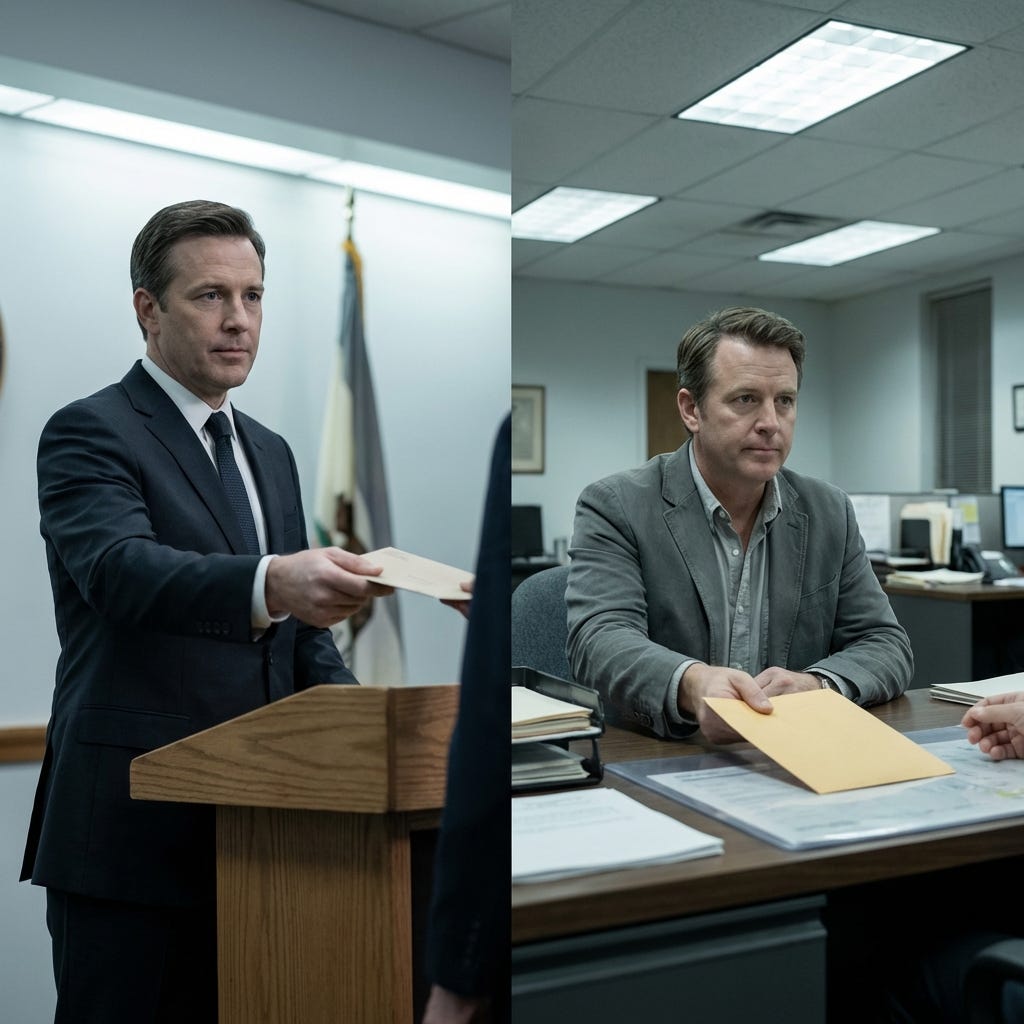
In the collective imagination, corruption wears a politician’s suit.
The consequence: an executive can endorse an illicit practice without ever triggering the word “corruption” in their own mind. Because that word, in their mental framework, belongs to someone else’s world.
This isn’t hypocrisy. It’s cognitive mechanics. And it’s far more dangerous than hypocrisy — because it can’t be fixed with more legislation.
It’s fixed by moving the mirror.
What you’ll find here
Every two weeks, The Blind Spot unpacks what you don’t see — or what you’re not shown — about corruption.
No academic jargon. No legal lectures. No moral lessons.
Research findings translated into plain language. Current events examined through the tools of social psychology. Questions nobody asks because they make people uncomfortable.
This newsletter is for people who make decisions — in a company, in an institution, in a civic life — and who want to understand the real mechanisms, not the official versions.
Why now
Corruption is everywhere in the news. It is nonetheless poorly understood — because we reduce it to its visible actors and forget its invisible mechanics.
My thesis is done. My findings are published in journals nobody reads outside universities.
That’s a problem.
The Blind Spot is my answer to that problem.
If you’re here, something in this promise resonated. The next issue arrives in two weeks.
It will open with a research finding that should unsettle everyone — and unsettles very few people, precisely because it concerns everyone.
See you then.